
Most advice about a rattling air conditioner starts with the wrong question. It asks what the sound is like. Is it a clatter, a buzz, a tick, a clunk?
Here’s what typically helps more: when the rattle happens. A noise that shows up only in the first few seconds after your system kicks on points to something completely different than one that gets louder the longer the unit runs. That single detail narrows things down faster than any description of the sound itself.
Quick answer: A rattle that lasts a few seconds at startup or shutdown is often normal or minor. A rattle that builds during a running cycle, or comes with weak cooling, usually needs a technician. And if you hear sizzling, sputtering, or popping from the outdoor unit, shut it off at the breaker and step away. That last one is a safety issue, not a repair question. If you’re unsure which category you’re in, an AC repair visit in Sandy, UT is the fastest way to get a real answer.
At One Stop Heating and Air Conditioning, timing is one of the first things we ask about over the phone. It’s not small talk. It changes what we bring on the truck.
Why Timing Tells You More Than the Sound Itself
Here’s some background that rarely makes it into homeowner articles. Compressor manufacturers organize noise by cycle phase, not by adjective.
Copeland’s Application Engineering Bulletin AE4-1331 R9 (September 2024) covers the scroll compressors found in a large share of 1.5 to 5 ton residential split systems. It handles startup sound, shutdown sound, and running sound in three separate sections, because they come from three separate mechanical events.
That’s the logic behind what we call the One Stop Cycle Timing Check: sorting an AC noise by the point in the cooling cycle when it happens, instead of by what it sounds like.
Three questions, in order:
- Does it happen only in the first few seconds after the unit kicks on?
- Does it happen only in the few seconds after it shuts off?
- Does it start quiet and grow the longer the system runs?
Your answer moves you toward one branch and away from the other two.
What It Means If Your AC Only Rattles at Startup
A brief noise at the start of a cycle is often the system clearing itself out.
Copeland’s bulletin explains that a compressor can fill with liquid refrigerant after a long off cycle, especially once it has cooled down. When it restarts, it has to clear that liquid, and the bulletin notes this can produce excessive start-up clearing noise, or cause the compressor to trip its internal overload protector a few times before it settles into a normal run.
Copeland’s engineering literature also points out that adding a crankcase heater cuts down on customer noise complaints, because the compressor no longer has to clear liquid during every start. Source: Copeland Application Engineering Bulletin AE4-1331 R9, September 2024
What this means for you: a short rattle at startup that goes away and doesn’t come back during the cycle is usually not an emergency. Worth mentioning at your next service visit, not worth a midnight call.
Two other startup-only possibilities:
- A loose fan blade brushing the shroud on the first rotations, before the fan reaches full speed
- The contactor engaging, which produces a single click and nothing more
The startup rattle that does concern us is one that repeats over and over because the system keeps cycling on and off. That’s a separate problem worth reading about in our piece on why an air conditioner keeps turning off randomly, and it’s one we see often across Salt Lake Valley homes.
What It Means If Your AC Only Rattles at Shutdown
Shutdown noise is common enough that manufacturers engineer around it.
The same Copeland bulletin describes three different built-in solutions used to reduce shutdown sound in scroll compressors: a cam-type device that separates the scrolls when they’re driven backward, a fluid brake, and a discharge port check valve. All three exist for the same reason. When the compressor stops, high-pressure gas equalizes back through it, and the scrolls can briefly spin in reverse.
The bulletin is direct about the durability question here. On heat pump systems where the reversing valve shifts at shutoff, it notes the compressor can slowly rotate backward until pressures equalize, and that this doesn’t affect compressor durability, though it can produce an unexpected sound after the system turns off.
Plain version: a clunk or short rattle right after your AC shuts down is often the system settling, not something breaking.
What It Means If the Rattle Grows the Longer It Runs
This is the timing window we take most seriously.
A rattle that starts faint and builds over ten or twenty minutes isn’t a pressure-equalization event. Those finish in seconds. A growing noise usually points to something heat-related or load-related: a part expanding, a bearing wearing, a mount failing, or an imbalance getting worse as speed and temperature climb.
Copeland’s bulletin gives one specific example that homeowners can actually use. It states that these scroll compressors stop pumping when the pressure ratio gets too high, and that there is an audible increase in sound when that unloading begins.
So a running noise paired with weak cooling isn’t two symptoms. It’s often one problem showing up two ways.
Harmless vs. Serious: A Side-by-Side Look
| What you notice | Timing | Likely category | What we’d suggest |
| Short rattle, then quiet | First 3 to 10 seconds of a cycle | Often normal (liquid clearing, fan spin-up) | Mention at next tune-up |
| Clunk right after shutoff | 1 to 5 seconds after the unit stops | Often normal (pressure equalizing) | Mention at next tune-up |
| Buzz that stops when you press a panel | Whole running cycle | Loose panel or cabinet resonance | Schedule service, no rush |
| Rattle from a vent | Only while air is moving | Loose register cover | Minor, easy fix at a service call |
| Noise that grows through the cycle | Builds over 10+ minutes | Possible mount, blower, or fan issue | Book a diagnostic |
| Rattle plus warm air | Whole cycle | Possible charge or compressor issue | Book a diagnostic |
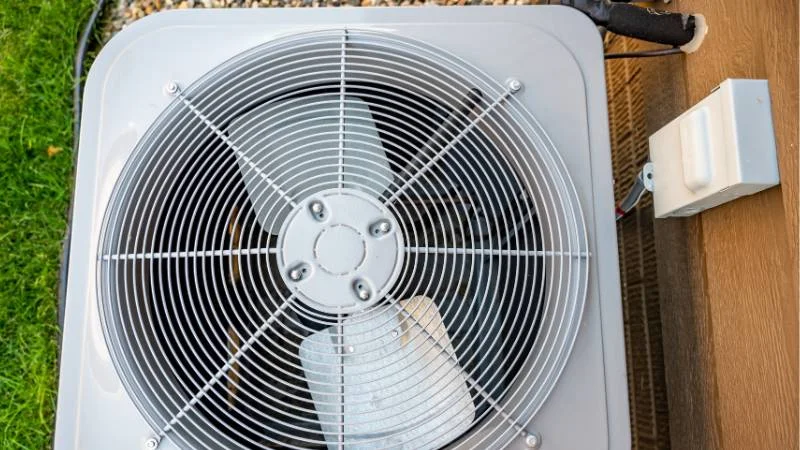
| Metal-on-metal, repeating each rotation | Any | Possible fan blade contact | Shut off, call |
| Sizzling, sputtering, popping | Any | Electrical hazard | Shut off at breaker, step away, call |
The “Harmless” Rattle That Has an Expiration Date
There’s one item on the harmless list that deserves a caveat, because it’s genuinely harmless right now and won’t stay that way.
A refrigerant line resting against a floor joist or wall stud buzzes. It’s annoying and it doesn’t hurt cooling performance. Most guides stop there.
Copeland’s bulletin adds something the rest leave out. It states that system tubing should be designed to keep tubing stresses below 9.5 ksi (62 MPa), the endurance limit of copper tubing, and that start, stop, and running resonance cases should each be evaluated.
That’s a hard engineering number. It exists because vibration fatigues copper over time. A line that has been buzzing against framing for three summers isn’t just noisy. It’s been loaded in exactly the way manufacturers design against.
Takeaway: a vibrating line set is a low-cost fix today and a refrigerant leak later. It’s one of the few AC noises where waiting genuinely changes the outcome.
Your AC Made a Strange Noise Right After the Power Flickered. Is It Broken?
Probably not, and this one is specific to how Utah weather behaves.
Copeland’s bulletin states that power interruptions shorter than half a second can cause powered reverse rotation in single-phase scroll compressors. High-pressure gas expands backward through the scrolls, and if power returns mid-reversal, the compressor may keep running backward until its internal overload trips. The bulletin says this will not damage the compressor, and once the overload resets, the unit starts and runs normally. It also notes that a compressor running in reverse will sometimes make an abnormal sound.
Why that matters here: the National Weather Service documents that strong downslope wind events hit the northern Wasatch Front every few years, with most events gusting into the 60 to 70 mph range for several hours. During the September 2020 event, gusts reached 91 mph at US 89 and Park Lane in Farmington and 89 mph at the University of Utah, with 70 mph gusts recorded in Bountiful, Centerville, and Millcreek. Routine NWS wind advisories for the Salt Lake Valley warn that a few power outages may result.
So a brief blip during a wind event, followed by an odd noise from the outdoor unit, has a documented explanation. If the noise clears within a cycle or two and cooling returns to normal, it likely resolves itself. If it doesn’t, that’s when to call.
Why Debris in the Cabinet Is a Bigger Deal in Sandy Than Most Places
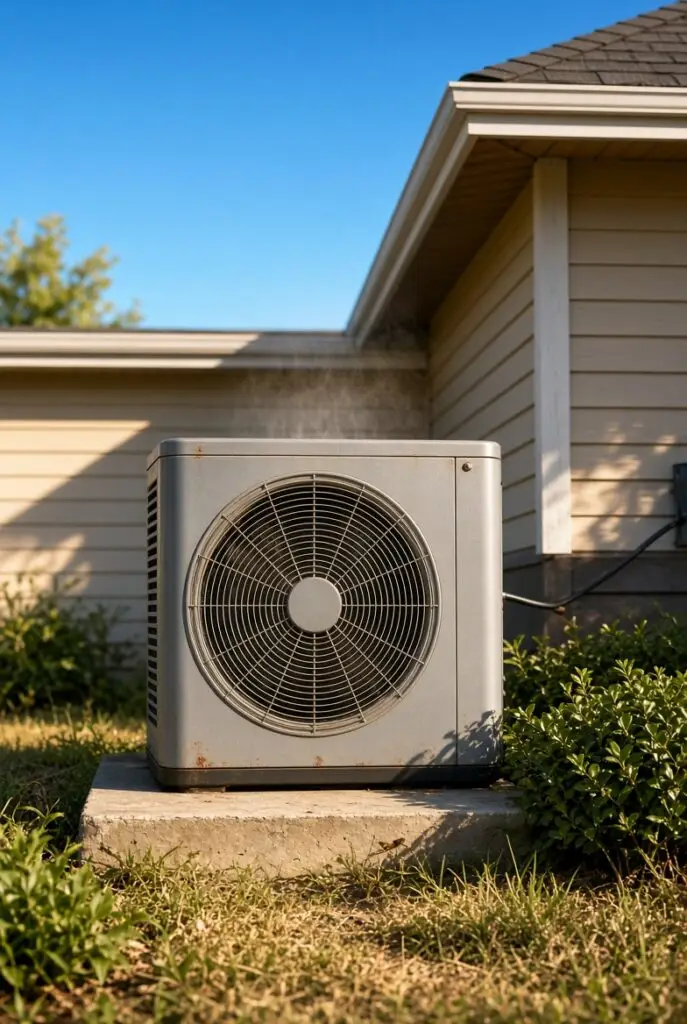
Loose debris inside an outdoor cabinet is a classic harmless rattle. In northern Utah, there’s simply more of it.
Research from the University of Utah has mapped dust hot spots across the Great Salt Lake’s exposed lakebed, which covers roughly 800 square miles. Kevin Perry, whose work focuses on how often that dust reaches the air and at what concentration, has noted that everyone along the Wasatch Front and Tooele Valley gets affected at certain times.
Bryce Bird, director of the Utah Division of Air Quality, has described wind pushing dust from Nevada across Tooele County into the Salt Lake Valley, with hourly fine particulate readings in Tooele climbing above the federal threshold of 35 micrograms per cubic meter.
A dust climatology from Salt Lake City International Airport found these events average 4.3 per water year, peaking in April and again in September.
That’s why coil and cabinet condition tends to slip here between seasons. And it’s not only a noise question. According to the ENERGY STAR maintenance checklist, airflow problems can reduce a system’s efficiency by up to 15 percent.
A note on the temptation to open the cabinet yourself: we’d rather you didn’t. Some parts of an AC are fine to clean and some aren’t, and we broke that down in detail in our guide on which parts you can touch and which belong to a technician.
When to Shut Your AC Off Right Away
Most rattles can wait until morning. A few can’t.
Copeland’s bulletin includes a precaution written for trained technicians, and it’s blunt. It instructs personnel to stay clear of the compressor when power is applied, and to get away immediately if unusual sounds come from it, because they can signal that terminal pin ejection may be about to happen. The bulletin describes those sounds as resembling electrical arcing: sizzling, sputtering, or popping.
The hazard behind that warning is called terminal venting. If a compressor’s electrical terminal pin loses its seal, pressurized oil, refrigerant, and debris can spray out. The bulletin states this material can be ignited by arcing at the terminal or any nearby ignition source, producing flames that may project a significant distance and cause serious or fatal burns.
The same bulletin also warns against resetting a breaker or replacing a blown fuse without proper electrical testing first, because a trip may indicate a compressor fault, and energizing a faulty compressor can cause terminal venting. Source: Copeland Application Engineering Bulletin AE4-1331 R9, September 2024
That instruction is written for professionals. It’s a good reason not to walk out and flip the breaker back on to see what happens.
Shut the system off and call if you notice:
- Sizzling, sputtering, or popping from the outdoor unit
- Metal-on-metal contact repeating with each fan rotation
- A rattle plus a burning smell
- A rattle plus a tripped breaker (leave the breaker off)
- Noise that started suddenly and is clearly louder than anything you’ve heard from the system before
If it’s in that list, emergency AC repair is the right call rather than waiting it out. We’re available around the clock across Sandy and the surrounding communities, including Draper, Riverton, Cottonwood Heights, West Jordan, and South Jordan.
If Your System Was Installed in 2025 or 2026, One Sound Isn’t a Rattle at All
This is worth knowing, and it’s rarely covered anywhere.
Newer systems use A2L refrigerants like R-454B and R-32, which replaced R-410A in new residential equipment manufactured or imported starting January 1, 2025 under the EPA’s Technology Transitions Rule. These refrigerants are classified as mildly flammable, so the equipment includes safety hardware that older systems don’t have.
UL Solutions states that under UL 60335-2-40, refrigerant leak detection systems must include both sensors and control logic that activate the evaporator fan to circulate air and dilute refrigerant if a leak is detected. Reporting from ACHR News adds that once the sensor stops detecting refrigerant, the system returns to normal operation, and that furnace and electric heat functions aren’t affected by the mitigation response.
What that means at home: if you have a system installed in the last year or so and the indoor blower turns on by itself with the thermostat off, that may not be a malfunction or a rattle. It may be the system doing exactly what it’s designed to do during a leak. Treat it as a service call, not a puzzle to investigate.
What About the Cost of Fixing It?
We’re not going to publish a number here, and it isn’t evasion.
The range between tightening a panel and replacing a compressor is enormous, and the honest answer depends on what a technician actually finds. Posting a figure would give you false confidence in either direction.
One thing we can tell you clearly, because it comes up: your working R-410A system does not need to be replaced because of the refrigerant rules. Existing R-410A systems can still be legally serviced, repaired, and recharged. What has changed is what’s available if you do need new equipment, and A2L refrigerant can’t simply be added to an older R-410A system.
On May 21, 2026, the EPA finalized a rule removing the January 1, 2026 installation deadline for residential systems using higher-GWP refrigerants, as long as the equipment was manufactured or imported before January 1, 2025. That rule was published May 26, 2026 and took effect July 27, 2026. Practically, it means pre-2025 inventory can still be installed until it runs out. You can review the current restrictions on the EPA’s Technology Transitions page.
If a diagnosis points toward replacement, ask for it in writing and ask what’s driving the recommendation.
How to Check That Your Utah HVAC Company Is Licensed
This is a quick step worth taking before anyone opens your equipment, and it changed recently.
The Utah Division of Professional Licensing (DOPL) created a new H100 HVAC Contractor classification, with the rule effective March 30, 2026 and new requirements beginning April 20, 2026. Per DOPL, qualifiers must hold RMGA or equivalent certification, pass both the Utah Business and Law Exam and the HVAC (H100) Exam through Prov, and document two years of HVAC-specific experience verified by W-2 forms. Insurance minimums were updated to $1 million per occurrence and $2 million aggregate, applying to all contractors. A fingerprint-based background check requirement takes effect January 1, 2027.
The classification replaces the older S350 specialty and moves to a qualifier model, meaning a licensed individual carries responsibility for the work performed.
You can verify any Utah contractor through DOPL’s public lookup at secure.utah.gov/llv. Our license number is M-201874, and we’d encourage you to look it up. It takes about two minutes.
Frequently Asked Questions
Is it safe to run my AC overnight if it’s rattling? It depends on the timing pattern. A brief rattle at startup or shutdown that doesn’t repeat during the cycle is usually fine until morning. A rattle that grows during the run, or one paired with warm air, a burning smell, or a tripped breaker, means shut it off. Anything that sounds electrical, like sizzling or popping, means shut it off and stay away from the unit.
My AC rattles and cools fine. Do I still need someone out? Not urgently, but yes eventually. Good cooling rules out several problems, not all of them. A vibrating line set is the clearest example: it cools perfectly and still fatigues copper over time. Getting it looked at during a scheduled visit costs far less than the leak it can turn into.
Can a dirty filter cause a rattling noise? A restricted filter is more likely to cause whistling or a strained sound than a rattle, though a loose filter in its slot can vibrate. Either way, it’s worth checking. The Department of Energy notes that replacing a clogged filter with a clean one can lower an air conditioner’s energy use by 5 to 15 percent, so it’s a small task with real return.
Why does my AC rattle more in the spring and fall? Debris. Dust events along the Wasatch Front average 4.3 per water year at Salt Lake City International Airport, with peaks in April and September. That’s when cabinets tend to collect the most material and when a rattle that wasn’t there in July suddenly appears.
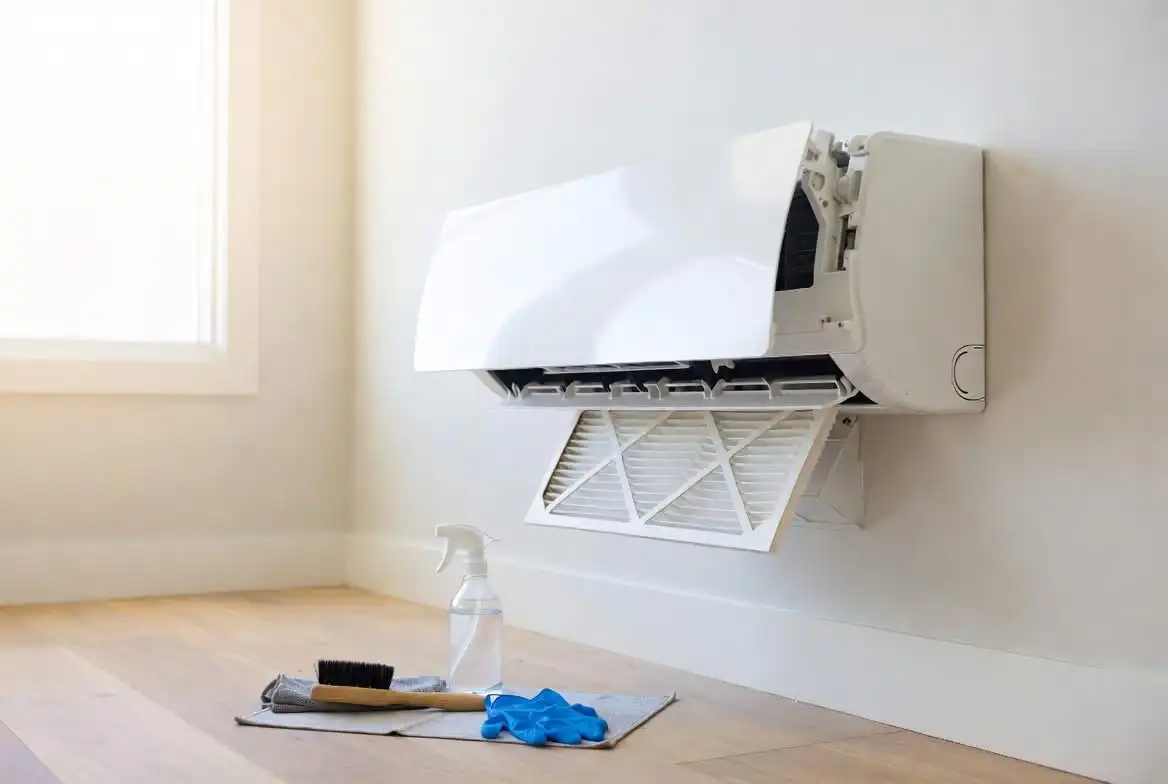
My mini split is making a rattling noise. Is it the same problem? Not usually. On a ductless system, the blower wheel sits inside the room rather than in a basement or attic, so imbalance and debris show up much more noticeably and much sooner. The diagnosis path differs enough that it’s worth telling us it’s a mini split when you call.
Does a rattling AC mean the compressor is dying? Not on its own. Compressor problems tend to come with other signs, such as weak cooling, repeated cycling, or a change in the running sound over time. A rattle by itself, with normal cooling and normal cycling, more often traces to hardware, debris, or vibration. A technician confirms it by measuring, not by listening.
Should I try tightening the panel screws myself? We’d rather you didn’t open the cabinet. Refrigerant lines, capacitors, and the contactor sit inside, and a capacitor can hold a charge after power is off. Note when the rattle happens, and let a technician handle the rest.
Tell Us When It Rattles, and We’ll Bring the Right Parts
The most useful thing you can do before calling is simple. Stand near the unit through one full cycle and note whether the noise shows up at startup, at shutdown, or builds while it runs. That one detail shortens the diagnosis considerably.
One Stop Heating and Air Conditioning serves Sandy, Bountiful, Farmington, Layton, Cottonwood Heights, Herriman, Holladay, Riverton, West Jordan, West Valley City, Tooele, American Fork, Eagle Mountain, Lehi, Saratoga Springs, Draper, Highland, South Jordan, Orem, and Salt Lake City. We’re available 24/7, and if you’re not sure whether your rattle can wait, that’s a fine question to ask us over the phone.
Call One Stop Heating and Air Conditioning, tell us when the noise happens, and we’ll take it from there.