
If your AC is blowing warm air this summer, you might assume it just needs a “refill.” It’s a common thought, and it makes sense on the surface. But here’s what most homeowners don’t realize: refrigerant doesn’t run out on its own.
If your system is low, something is leaking, and that leak isn’t going to fix itself.
At One Stop Heating and Air Conditioning, we see this situation regularly across Sandy, UT, and surrounding communities like Draper, South Jordan, and West Valley City. Homeowners often wait too long, the problem quietly gets worse, and what could have been a straightforward repair turns into a compressor replacement. That’s an expensive lesson nobody wants.
So let’s break this down clearly, starting with what’s actually happening inside your system.
Refrigerant Doesn’t “Run Out” — So Why Is Your AC Low?
Your air conditioner is a sealed, closed-loop system. Refrigerant circulates continuously to absorb heat from inside your home and release it outside. It doesn’t get used up the way gas does in a car. According to the EPA and 2025 HVAC industry guidance, if your system is low on refrigerant, there is a leak somewhere in the lines, coils, valves, or connections.
Think of it like a bicycle tire. Air doesn’t disappear on its own. If it’s flat, there’s a hole.
Field data from 2025 service reports shows that residential systems experience average annual leak rates of around 5 to 11% of total charge, with some studies citing 5.3% for central AC and heat pumps. That number might sound small, but over a season, the impact on performance and operating costs adds up fast.
If you’re noticing your home isn’t cooling like it used to, it could be time to look into air conditioning repair in Sandy, UT. The earlier a leak is caught, the better.
6 Signs Your AC Might Be Low on Refrigerant
Low refrigerant doesn’t always announce itself loudly. Sometimes it sneaks up on you through subtle changes that are easy to dismiss.
Here’s what to watch for:
| Sign | What It Looks Like | Why It Happens |
| Warm or weak airflow | Air from vents feels lukewarm | Not enough refrigerant to absorb indoor heat |
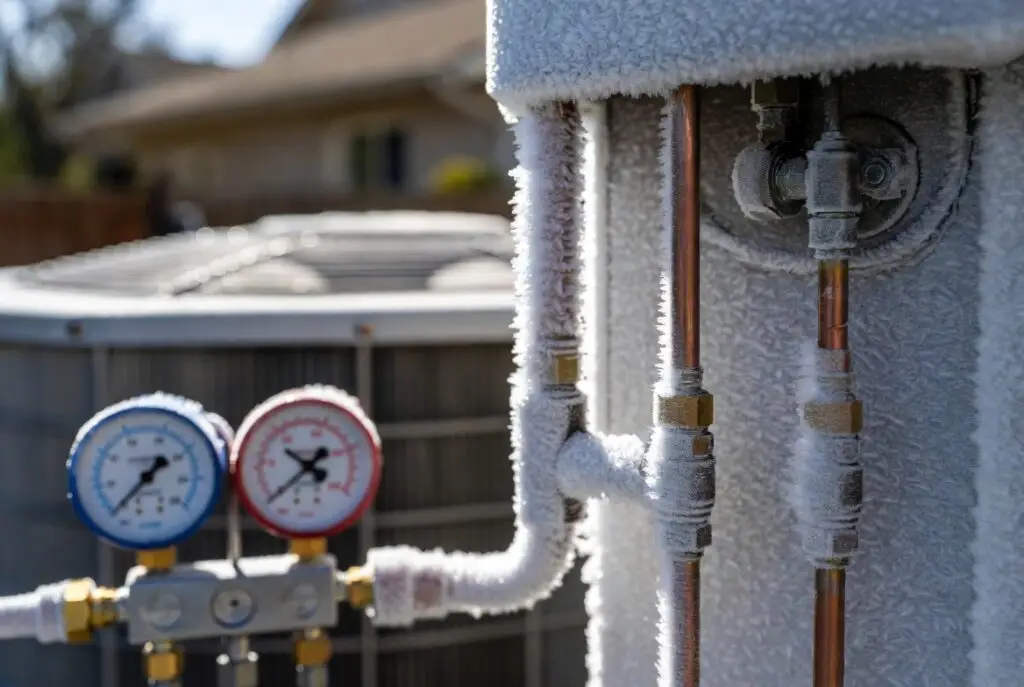
| Ice or frost on lines or coil | Visible freezing on the indoor unit | Low pressure drops coil temp below freezing |
| AC runs constantly | System never reaches set temperature | Reduced heat transfer forces continuous operation |
| Higher energy bills | Sudden spike during summer months | System works 10 to 30% harder to compensate |
| Hissing or bubbling sounds | Audible near the unit or refrigerant lines | Active leak under pressure |
| Water pooling near the indoor unit | Dripping or puddling after system runs | Ice on coil melts when system cycles off |
A few of these showing up at once? That’s a strong signal that refrigerant levels are worth checking.
One thing worth knowing: a 10% undercharge can noticeably reduce cooling capacity. A drop of 20% or more can push efficiency down steeply and risk overheating the compressor due to poor lubrication and heat dissipation, according to 2025 service references from regional and national HVAC providers, which also align with U.S. Department of Energy explanations of common AC problems.
What Happens If You Just “Top It Off”?
This is where a lot of people run into trouble.
Adding refrigerant without finding and fixing the leak is like putting a bandage on a hole in a pipe. You might get a few more weeks of cooling, but the refrigerant will keep leaking, the pressure will drop again, and you’ll be back in the same situation, except now the compressor has been working under stress the whole time.
The compressor is the most expensive component in your system. Once it fails, repair costs climb fast, and on older systems, it often makes more financial sense to replace the whole unit.
There’s also a legal side to this. Under EPA regulations, only EPA Section 608-certified technicians are allowed to handle, recover, or recharge refrigerant. Venting refrigerant is strictly prohibited nationwide, including here in Utah. Attempting a DIY refrigerant top-off doesn’t just risk your system. It’s a federal violation.
How a Certified Tech Finds and Fixes a Refrigerant Leak
When one of our technicians at One Stop Heating and Air Conditioning inspects a system for low refrigerant, the goal isn’t just to add refrigerant and move on. The goal is to find where it’s going.
Certified technicians use a combination of:
- Electronic leak detectors sensitive to parts-per-million levels
- Nitrogen pressure testing to identify hard-to-spot leaks
- UV dye that glows under a black light to pinpoint the exact source
- Soap solution testing for surface-level checks at joints and connections
Common leak sources include pinhole corrosion in copper lines (often caused by formic acid formation), worn seals, coil damage, and vibration-related wear at fittings. Once the leak is repaired, the system is recharged to manufacturer specifications, not just “topped off” to a ballpark number.
This is the approach that prevents repeat issues and protects your equipment long-term.
What the New 2025–2026 Refrigerant Rules Mean for You
If you’ve heard anything about refrigerant regulations changing, here’s a clear summary of what’s actually happening and what it means for your home.
| Date | What Changed | What It Means for Homeowners |
| January 1, 2025 | New systems must use refrigerants with GWP below 700 | New installs use A2L refrigerants like R-32 or R-454B |
| January 1, 2026 | HFC Management Rule takes effect for systems with 15+ lbs of refrigerant | Leak rate tracking and repair triggers required for larger systems |
| January 1, 2026 onward | Limited installation allowances for pre-2025 components | Some R-410A parts may still be installed under qualifying conditions |
| Ongoing | EPA Section 608 certification required for all refrigerant handling | Only licensed techs can legally service your refrigerant system |
What about your existing R-410A system? If your home’s AC was installed before 2025, you’re not required to upgrade immediately. Existing systems remain fully serviceable with reclaimed or recycled refrigerant. However, R-410A availability is tightening, and if your system is repeatedly losing refrigerant, the cost math often starts favoring replacement over continued repairs, especially on units 12 to 15 years old.
New A2L systems (using refrigerants like R-32 or R-454B) also come with built-in refrigerant detection sensors that shut the system down if a leak is detected. That’s a meaningful safety and efficiency improvement worth knowing about.
These federal rules apply uniformly across the country, including here in Sandy, Lehi, Herriman, Cottonwood Heights, and all Salt Lake Valley communities. No Utah-specific deviations change the baseline requirements for residential systems.
Should You Repair or Replace an AC That’s Leaking Refrigerant?
This question comes up a lot, and the answer genuinely depends on your specific situation.
A few factors that push toward repair:
- System is less than 8 to 10 years old
- Leak is localized and accessible
- No other major components are showing wear
A few factors that push toward replacement:
- System is 12 to 15 years old or older
- This is the second or third refrigerant recharge in recent years
- Compressor is already showing strain
- Unit uses R-410A and is losing charge frequently
At One Stop Heating and Air Conditioning, we walk through both options honestly so you can make the call that makes the most sense for your home and budget. No pressure, just a clear picture of what’s going on.
Don’t Wait Out a Warm Summer Night to Find Out
Utah summers push AC systems hard. A system that’s low on refrigerant during a stretch of 95-degree days isn’t just uncomfortable. It’s actively being damaged every hour it runs undercharged.
The good news is that catching a leak early is almost always the least expensive outcome. If you’re noticing any of the signs described above, reaching out to a certified HVAC technician sooner rather than later is genuinely the better move.
One Stop Heating and Air Conditioning serves Sandy, UT, and communities throughout the Salt Lake Valley, including Draper, Riverton, West Jordan, American Fork, Orem, Salt Lake City, and more. Our HVAC professionals in Provo, UT are EPA-certified, we handle leak detection and refrigerant repairs correctly the first time, and we’re upfront about what your system actually needs.
Contact One Stop Heating and Air Conditioning today to schedule an inspection. A quick check now can save you from a much bigger problem this summer.
Frequently Asked Questions
Why is my AC low on refrigerant if I never added any? Refrigerant doesn’t get consumed during normal operation. If levels are low, your system has a leak somewhere in the sealed circuit. This could be in the copper lines, the coils, the valves, or at a fitting. Only a certified HVAC technician in Salt Lake City, UT can locate and properly repair it.
Can low refrigerant cause my AC to freeze up? Yes. Low refrigerant drops system pressure, which causes the evaporator coil temperature to fall below freezing. Ice forms on the coil or suction lines, restricts airflow, and eventually melts when the system cycles off, which can cause water damage near the indoor unit.
Can I add refrigerant to my AC myself in 2026? No. Under EPA Section 608, only certified technicians are legally allowed to handle, recover, or recharge refrigerant. Attempting it without certification carries federal penalties. It also risks further damage to your system if charged incorrectly.
Does low refrigerant damage the compressor? It can, yes. A significant undercharge reduces lubrication and heat dissipation inside the compressor, causing it to overheat and wear out faster. The compressor is typically the most expensive component in an AC system, so protecting it matters.
What should I do if my AC is blowing warm air this summer? Start by checking your air filter and making sure the thermostat is set correctly. If those aren’t the issue, the most likely causes are a refrigerant leak, a dirty evaporator coil, or a failing component. A certified HVAC tech can diagnose it quickly and recommend the right fix.
What happens to my R-410A system now that new refrigerant rules are in effect? Your existing R-410A system can still be serviced and recharged using reclaimed or recycled refrigerant. The new rules primarily affect newly manufactured equipment. That said, if your system is aging and repeatedly losing refrigerant, it’s worth discussing replacement options with a technician, since R-410A availability is gradually decreasing and repair costs on leak-prone older units add up over time.
Does One Stop Heating and Air Conditioning serve areas outside of Sandy, UT? Yes. One Stop Heating and Air Conditioning serves Sandy and a wide range of surrounding communities, including Draper, South Jordan, West Jordan, Riverton, Herriman, Holladay, Cottonwood Heights, Salt Lake City, Orem, Lehi, American Fork, Eagle Mountain, Saratoga Springs, Bountiful, Farmington, Layton, West Valley City, and Tooele.