
Most guides on cleaning an indoor AC unit hand you five steps and stop. What they don’t tell you is where those steps quietly cross from “helpful maintenance” into “that repair could have been avoided.”
Here’s the short version. You can safely clean the filter, the return grille, the outside of the cabinet, the visible drain opening, and your supply registers. The evaporator coil, the blower wheel, and the inside of the drain pan belong to a technician, because each one has a mechanical reason it fails when handled wrong.
If you’ve already opened a panel and something looks wetter, dirtier, or more corroded than you expected, that’s the point to stop and get eyes on it. Our team handles air conditioning services in Sandy, UT and the surrounding Wasatch Front, and a fair number of the calls we take start with a homeowner who was doing everything right until one part of the job went sideways.
The Short Answer: What You Can Clean and What You Can’t
Direct answer: Yes, you can clean parts of an indoor AC unit yourself without damaging it, as long as you stay outside the sealed cabinet. Cleaning the filter, grilles, registers, and exterior surfaces is homeowner work. Cleaning the coil, blower wheel, or drain pan interior involves torqued components, refrigerant lines, and chemical compatibility questions that require a licensed technician.
That split is the whole point of this post.
The One Stop Damage Line: Where Homeowner Cleaning Stops Helping
We call it the damage line. It’s the point where cleaning stops improving performance and starts creating repair costs. It falls in the same place on nearly every residential system, and it’s easy to remember as five and three.
The 5 Parts on Your Side of the Line
- Air filter. The single highest-value thing you can do. The U.S. Department of Energy’s Energy Saver guidance states that swapping a clogged filter for a clean one can cut an air conditioner’s energy use by 5% to 15%.
- Return grille. The EPA notes that return registers naturally collect dust because dust-laden air is pulled through the grate, and that this is not a sign of contaminated ductwork. Vacuum it or take it down and wash it.
- Cabinet exterior and blower housing exterior. A damp cloth on the outside. Nothing sprayed toward seams or openings.
- The visible condensate drain opening. Look at it. Clear leaves or lint sitting right at the mouth. That’s the limit.
- Supply registers. ANSI/ACCA 4 QM, the national residential HVAC maintenance standard reaffirmed by ANSI in August 2024, lists inspecting grilles, registers, diffusers, and balancing dampers for dirt buildup and cleaning as needed.
The 3 Parts on the Technician’s Side, and Why
Evaporator coil. DOE points out that the aluminum fins on evaporator and condenser coils bend easily and, once bent, block airflow through the coil. Bryant, a Carrier Global brand, tells homeowners directly not to put vinegar, bleach, or standard household cleaners on an evaporator coil, since those can degrade the aluminum fins and copper tubing, and warns that pressure washers bend fins.
Blower wheel. ACCA’s standard asks technicians to confirm the blower wheel has a tight connection to the motor shaft, check for free rotation and minimal endplay, and measure amp draw against OEM specification. That’s a torqued, measured assembly, not a surface you wipe. Clean one side more than the other and you’ve changed how a balanced rotating part behaves. There’s no published threshold for how much residual buildup causes imbalance, so we won’t invent one. We’d just rather a tech assess it.
Drain pan interior. More on this below, because it’s where the worst advice online lives.
Before You Open a Single Panel: Power, and the 2025 Sensor Question
Turn off power at the thermostat and at the breaker. Not one or the other. The blower can energize on a call for heat or cool while your hands are inside the cabinet.
Then there’s something almost nobody is writing about yet.
Under EPA’s AIM Act Technology Transitions Rule, manufacturers stopped producing residential AC and heat pump equipment charged with R-410A on January 1, 2025. New residential systems use A2L refrigerants, mainly R-454B and R-32, which carry lower global warming potential.
Here’s why that touches a cleaning project. UL Solutions explains that when UL 60335-2-40 requires it, a refrigerant detection system is evaluated as part of the equipment’s certification and has to be installed inside the HVAC equipment exactly as the manufacturer’s instructions specify. UL notes these systems are typically designed to trigger mitigation within 15 seconds of sensing refrigerant at 25% of the lower flammability limit.
Not every new unit has one. UL is clear that whether a given model requires an integral sensor is determined during certification, and placement varies by model. So the honest instruction is this: if your indoor unit was installed in 2025 or later, check the installation manual or ask your installer whether it carries a refrigerant detection system before you open any panel. Spraying cleaner near a factory-placed sensor, wiping it, or putting a panel back slightly out of position isn’t a cosmetic issue.
The 10-Second Flashlight Test That Tells You If the Coil Is Dirty
You don’t need to open the cabinet to get a useful read. EPA’s own post-cleaning consumer checklist includes a test any homeowner can run: shine a flashlight into the cooling coil and see whether light comes through the other side. On a clean coil, it should. The checklist also asks whether the fins are straight and evenly spaced rather than bent over and smashed together.
If light doesn’t pass through, that’s your answer. The coil needs a technician, not a can of spray. And if the fins are already flattened, cleaning around them won’t restore the airflow you lost.
We use this same check on maintenance visits. It’s simple, it’s federal guidance, and it takes less time than reading the label on a coil cleaner.
Safe to Clean vs. Stop and Call: A Side-by-Side
| Component | Your job? | What goes wrong if you push past it |
| Air filter | Yes | Almost nothing. Handle gently, don’t shake it |
| Return grille | Yes | Minimal. Vacuum or wash and dry fully |
| Supply registers | Yes | Minimal. Watch for bent balancing dampers |
| Cabinet exterior | Yes | Moisture entering seams if oversprayed |
| Drain opening (visible) | Look only | Pushing debris deeper into the line |
| Evaporator coil | No | Bent fins block airflow; wrong chemicals attack aluminum and copper |
| Blower wheel | No | Set screw, shaft fit, and balance are spec items with measured amp draw |
| Drain pan interior | No | Chemical compatibility with pan and coil materials is model-specific |
The Bleach and Vinegar Question, Answered Honestly
This is the most contradictory topic in home HVAC advice, and we’d rather give you a straight non-answer than a confident wrong one.
There is no consensus, citable, manufacturer-wide rule on bleach versus vinegar in condensate drain lines. Contractor blogs disagree with each other. Some anecdotal reports mention PVC and pan damage, but we haven’t found that documented in a primary source, so we’re not going to repeat it as fact.
What is documented: ACCA’s national standard tells technicians to inspect the drain pan and accessible drain line for biological growth, clean as needed, and add algae tablets or strips as necessary, while ensuring those tablets and cleaning agents are compatible with the fin and tube material. That’s an ANSI-approved standard saying material compatibility is a required consideration, not an optional one.
So the correct answer is model-specific. Your equipment’s installation and service manual governs. If you don’t know what your pan and coil are made of, that’s a good moment to hand it off.
One safety point that is not in dispute: never mix bleach with vinegar or with ammonia-based cleaners. Chlorine bleach combined with acids releases chlorine gas. This applies in a utility closet the same as it does under a kitchen sink.
Why Filters Load Faster Along the Wasatch Front
EPA notes that manufacturers commonly recommend filter replacement every 60 to 90 days, and suggests changing more often if filters look heavily soiled when you pull them.
Local conditions push against that baseline. Utah DEQ reports that a typical Utah winter brings roughly 5 to 6 multi-day inversion episodes and, on average, 18 days where PM2.5 exceeds the National Ambient Air Quality Standard. The Salt Lake, Utah, and Cache valleys are designated nonattainment areas for PM2.5. During the week of January 12 to 15, 2026, several Salt Lake Valley cities recorded some of the worst air quality readings in the country, with mandatory no-burn restrictions in place, according to Utah News Dispatch.
Practical takeaway: check your filter monthly here rather than assuming the box’s 90-day number applies. And on MERV rating, EPA’s guidance is to use the highest efficiency filter recommended by your system’s manufacturer, not the highest efficiency filter on the shelf. A filter that’s too restrictive for your blower creates its own airflow problem.
One more small thing that almost never gets mentioned. EPA’s filter-handling guidance suggests wearing gloves and eye protection, removing filters gently and outdoors when possible, avoiding shaking or banging them, and bagging them for disposal. Shaking a loaded filter over the trash can undoes part of what the filter was doing for you.
I Cleaned Everything and It Still Isn’t Cooling
This is the most common follow-up we hear, and there’s a good reason for it.
Research from Lawrence Berkeley National Laboratory on evaporator coil fouling found that typical coils foul enough to double evaporator pressure drop within 7 to 11 years, well short of the 15 to 30 year coil lifetime people expect. The study identified filter efficiency and indoor particle concentration as the most important factors. Resulting capacity and efficiency losses are usually under 5%, though they can run much higher on marginal systems or in extreme conditions.
Translation: a clean filter slows coil fouling. It doesn’t stop it. If you’ve cleaned everything on your side of the damage line and cooling is still weak, that’s the expected outcome for a system that’s crossed the fouling threshold.
There’s also a category difference worth naming. Cleaning is a visual task. Diagnosis is a measurement task. ACCA’s checklist for evaporator sections asks a technician to confirm airflow using delta-T and static pressure against the OEM target, record dry bulb and wet bulb temperature difference across the coil, measure pressure drop across the coil, inspect refrigerant lines and joints for oil staining that indicates leaks, and check whether condensate is blowing off the coil into the cabinet or ducts.
None of that is visible from the return grille. If you want those numbers on your system, a scheduled AC maintenance visit is where they come from.
What to Do If You See Mold Inside the Unit
EPA sets a bright line here. If mold growth covers more than about 10 square feet, EPA advises consulting its Mold Remediation in Schools and Commercial Buildings guide and considering a contractor experienced in mold cleanup.
More important than the square footage: EPA says not to run the HVAC system in Bountiful, UT if you know or suspect it’s contaminated with mold, because running it can spread mold through the building.
Two related points. EPA states that insulated ducts that get wet or moldy can’t be effectively cleaned and should be removed and replaced, a position shared by NADCA and NAIMA. And EPA notes that confirming whether a substance is actually mold requires an expert and may need lab analysis, so a visual guess isn’t a diagnosis.
Should You Just Get the Ducts Cleaned Instead?
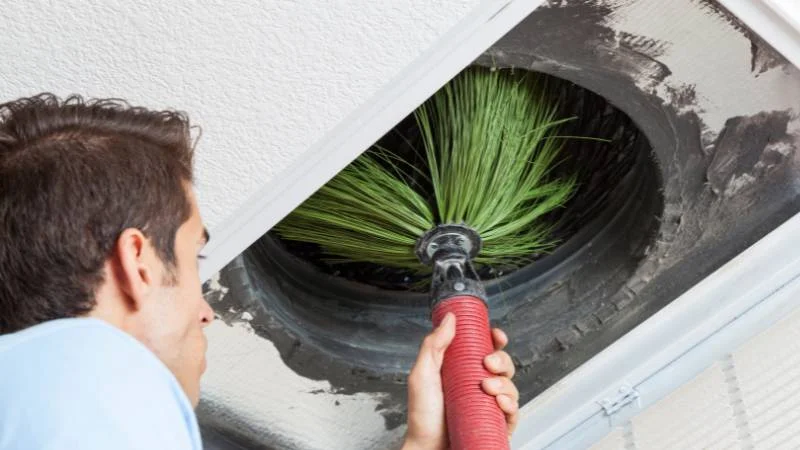
Probably not as a routine step. EPA’s position is that some research suggests cleaning components like cooling coils, fans, and heat exchangers may improve efficiency and extend operating life, but that little evidence exists that cleaning ducts alone improves system efficiency.
EPA also says a dusty return register is normal and does not by itself indicate contaminated ductwork. And it warns against providers who claim duct cleaning delivers health benefits, since those claims are unsubstantiated.
One firm rule from EPA that applies to any DIY attempt: steam cleaning and other moisture-based methods should not be used on any kind of ductwork.
Ductless Mini Splits: Same Line, Different Hardware
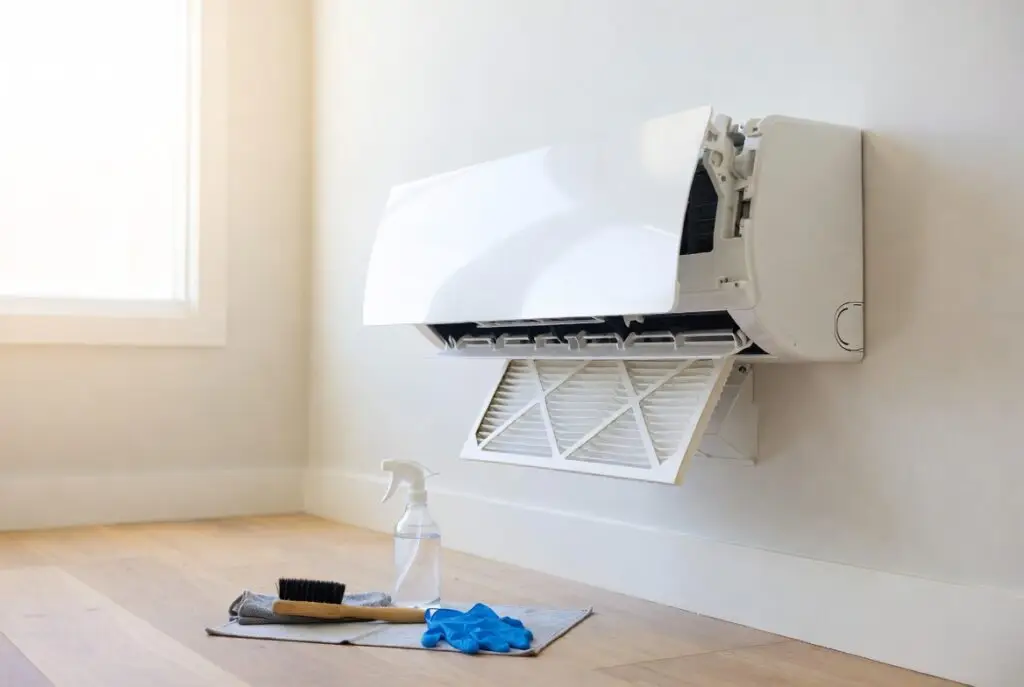
If you have a wall-mounted head, the filters slide out and rinse clean. That part is genuinely homeowner work and it’s worth doing monthly here.
The blower wheel is not. On a high-wall unit, reaching it means releasing the drain pan assembly and loosening a set screw that fixes the wheel to the motor shaft, per HVAC School’s mini split service guidance. Reassembly position and torque both matter. Mini split coil, wheel, and pan work is service work, same as on a ducted system.
A Note on Chemicals, From Someone Who Teaches Technicians
Bryan Orr, founder of HVAC School, told ACHR News in May 2026 that the tendency he sees most in less experienced technicians is assuming stronger chemical concentration and higher pressure produce a better clean. As he described it, the wrong cleaner or too much pressure can damage the coil, harm surrounding materials, and create risk for both the technician and the customer’s property, and technique matters especially on modern equipment and microchannel coils.
Paraphrased from ACHR News, “Modern Coils, New Risks: Rethinking HVAC Cleaning Practices,” May 13, 2026.
HVAC School’s coil cleaner guide adds a related point: on a coated coil, high-alkaline or acidic cleaners will strip the coating off, and over-concentrated cleaner can damage paint and wire insulation. Trane’s service literature on microchannel condenser coils goes further, calling for pressurized water or air only, with no detergents, and a fin comb for straightening bent fins.
If professionals are being cautioned about concentration and pressure, that tells you something about the margin for error with a hardware store spray can.
One Legal Boundary Worth Knowing
Under Section 608 of the Clean Air Act (40 CFR Part 82, Subpart F), it’s prohibited to intentionally vent ozone-depleting substances or their substitutes, including HFCs like R-410A, while maintaining, servicing, repairing, or disposing of AC equipment. EPA also requires Section 608 certification for anyone purchasing refrigerant for a stationary appliance or handling refrigerants.
In plain terms: any cleaning task that could open, disturb, or puncture the refrigerant circuit is outside what a homeowner may legally do. That includes work close to line connections inside the cabinet.
Separately, using a biocide or antimicrobial product inside a duct or air handler in a way inconsistent with its label is a violation of federal pesticide law, and EPA notes that no biocides are registered for fiberglass duct board or fiberglass-lined ducts.
Before You Book Anyone in Utah, Run This Check
Utah’s HVAC contractor licensing classification is changing, and it’s worth two minutes of your time.
Per the Utah Division of Professional Licensing, starting April 20, 2026, applications for the H100 HVAC Contractor classification must meet updated requirements including RMGA or equivalent certification, passing the Utah Business and Law Exam and the H100 HVAC Exam through Prov, and documenting two years of HVAC-specific experience verified by W-2 forms. The H100 replaces the legacy S350 HVAC Contractor specialty classification, with a transition window for existing S350 holders running through November 30, 2027.
Also relevant if the visit turns into a repair: Utah Code § 58-55-305, as amended by HB 483 (2024) effective May 7, 2025, requires a licensed contractor for alteration, repair, remodeling, addition, or improvement of a building valued at $7,000 or more, counting labor and materials together.
How to verify: go to the DOPL Licensee Lookup at dopl.utah.gov, select CONTRACTOR, and confirm active status. Do that for us or for anyone else you’re considering.
Ready to Find Out What’s Behind Your Filter?
You’ve done the part that’s yours to do. The filter’s clean, the grille is clear, the registers are open. If the flashlight test came back dark, or the cooling still feels weak, or you found standing water in the pan, the next step involves measurements rather than a cloth.
At One Stop Heating and Air Conditioning, we serve Sandy and neighboring communities including Draper, South Jordan, West Jordan, Riverton, Herriman, Holladay, Cottonwood Heights, Salt Lake City, Lehi, American Fork, and Orem. We’ll check static pressure and delta-T against your system’s targets, inspect the coil and blower wheel properly, and tell you plainly whether cleaning is the answer or whether something else is going on.
Give us a call and we’ll take a look before the next stretch of heat arrives.
Frequently Asked Questions
Do I really need to turn off the power before cleaning my indoor AC unit? Yes. Shut it down at the thermostat and at the breaker panel. The blower can start on a thermostat call while you’re working, and a spinning wheel doesn’t care that a panel is open.
Can cleaning an AC unit actually damage it? It can, in specific ways. Bent coil fins restrict airflow, the wrong chemical attacks aluminum fins and copper tubing, and pressure that seems modest to you can flatten a coil. Staying on the homeowner side of the damage line avoids all three.
Can I use a household cleaner on my evaporator coil? Bryant advises against vinegar, bleach, and standard household cleaners on evaporator coils, citing damage to aluminum fins and copper tubing. HVAC School adds that high-alkaline and acidic cleaners strip coatings from coated coils. Skip it.
Is a dusty return vent a sign my ducts are dirty? No. EPA states that return registers naturally collect dust as air is drawn through them, and that this doesn’t indicate contaminated ductwork. Vacuum it and move on.
Why does my AC smell musty after I changed the filter? A musty odor often points toward moisture in the cabinet or pan rather than the filter. EPA notes that cooling coils remove water from the air and can be a major source of moisture contamination, and that standing water or debris in the pan signals a problem needing immediate attention. Have someone look at the pan and drain.
Why is there water on the floor around my indoor unit? Common causes include a blocked or improperly sloped drain, or condensate blowing off the coil into the cabinet. Both are on the technician’s checklist. Turn the system off so you’re not adding water while you wait.
My coil froze up after I cleaned things. What happened? Freezing usually traces back to airflow restriction or a refrigerant issue, and both need measurement to sort out. Shut the system off, let it thaw fully, and get it diagnosed rather than restarting it repeatedly.
Does cleaning my AC actually save energy? For filters, yes. DOE puts the energy consumption reduction from replacing a clogged filter at 5% to 15%. For ducts alone, EPA says there’s little evidence of efficiency improvement, which is why we don’t push duct cleaning as routine.
How do I know if my new system has a refrigerant sensor inside? Check the installation instructions or ask whoever installed it. UL is clear that whether a unit carries an integral refrigerant detection system is determined during certification and that placement is model-specific, so there’s no safe blanket assumption either way.
Should I switch to the highest MERV filter I can find? No. EPA’s guidance is the highest efficiency filter recommended by your system’s manufacturer. A filter that restricts more than your blower is designed for creates the airflow problem you were trying to solve.