
Your air conditioner kicks on, runs for a few minutes, then shuts off. A little while later it does the same thing again. The house never really gets comfortable, and you’re left wondering if something is broken or if this is just how it works.
Here’s what typically happens when an AC turns off too soon: the unit is “short cycling,” which means it stops before finishing a full cooling cycle. Sometimes the fix is as simple as a clogged filter you can swap in five minutes. Other times it points to a refrigerant, electrical, or sizing issue that needs a licensed technician. If your unit is shutting off every few minutes and the room still feels warm, it’s worth getting a look from a pro who handles emergency AC repair before the problem stresses your system further.
Below, we’ll walk through what normal cycling looks like, the things you can safely check yourself, and the issues you should leave to a trained tech. At One Stop Heating and Air Conditioning, we’ve helped many Sandy-area homeowners sort the harmless causes from the urgent ones, and the pattern of how your unit shuts off usually tells us a lot.
What Counts As Normal AC Cycling Versus Short Cycling
Before you panic, it helps to know what healthy cycling looks like.
Industry guidance suggests a properly working air conditioner cycles 2 to 3 times per hour during peak heat, with each run lasting roughly 15 to 20 minutes. A separate sizing source frames the healthy window as 10 to 20 minutes per cycle under normal conditions, and flags anything under 10 minutes as a red flag.
So a quick gut check:
- Runs 15 to 20 minutes, then rests: usually normal.
- Runs only a few minutes, then quits, over and over: that’s short cycling, and it’s worth investigating.
- Cycles a lot more often on a 100-degree afternoon: can be normal during extreme load, but constant on-off is still a sign to check.
Why does it matter? The compressor takes the most mechanical stress during startup. A stop-and-start pattern wears that part faster, which shortens equipment life and leads to more frequent repairs. Catching short cycling early can save you from a bigger bill later.
The Three Things You Can Safely Check Yourself
Some causes of short cycling are simple, and you can rule them out without any tools. These are the “check-yourself” tier.
1. A dirty or clogged air filter. This is the single most commonly cited cause. A filter packed with dust restricts airflow, which can cause your system to overheat and shut down early. Swap it out and see if the cycling settles.
2. Closed or blocked vents and registers. When too many vents are shut or covered by furniture, pressure builds inside the system and trips it off. Walk the house and make sure supply vents are open and clear.
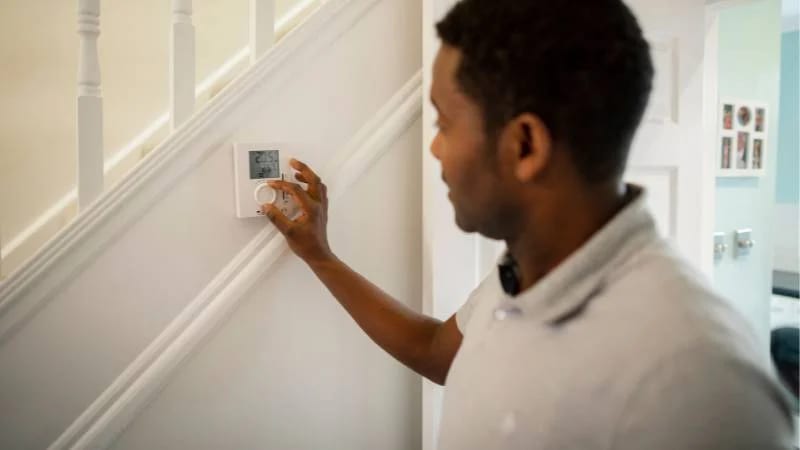
3. Thermostat settings or placement. A thermostat sitting in direct sun, near a heat source, or above an open vent can read the wrong temperature and cut the unit off too soon. Check the settings and where it’s mounted.
If you’ve handled all three and your AC still turns off randomly, the cause likely sits in the next tier, which calls for a professional.
When Short Cycling Means You Need a Licensed Technician
These causes are harder to spot and riskier to handle without training. We don’t recommend a DIY approach with any of them.
Low Refrigerant Or A Refrigerant Leak
Yes, low refrigerant can make your AC keep turning off. When the charge drops, pressures fall out of range and the system can trip its safety controls. Refrigerant doesn’t get “used up” in a sealed system, so low levels usually mean a leak that needs to be found and sealed by a tech.
Frozen Evaporator Coils
Restricted airflow or low refrigerant can cause the indoor coil to ice over. A frozen coil can absolutely make your AC shut off, since the system can’t move heat properly once it’s covered in ice. This often shows up alongside a dirty filter or a refrigerant problem.
Electrical Faults
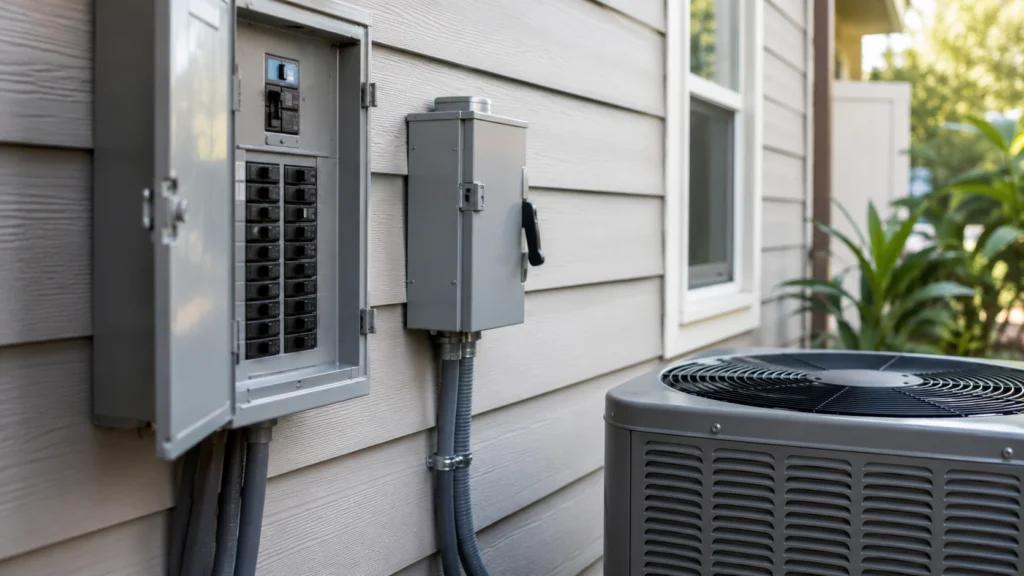
Faulty wiring, corroded connections, or a failing control board can cause erratic on-off behavior. Carrier’s guidance adds that bad capacitors or relays can also trigger short cycling. These are more complex and more dangerous to diagnose without training, so they belong with a qualified tech.
An Oversized System (The Hidden Root Cause)
Here’s the cause most homeowners never hear about. If your unit is too big for your home, it cools the air fast, satisfies the thermostat, and shuts off before completing a real cycle. Then it starts again a few minutes later. The result is constant short cycling that no filter change will fix.
This is more common than people think. The U.S. Department of Energy estimates that over 50% of HVAC contractors size systems incorrectly. Even careful sizing leaves a built-in margin, since equipment only comes in a limited number of sizes, so a unit often runs 10 to 15% oversized just from rounding up to the next available size. ENERGY STAR’s new-homes program caps oversizing at 15% and points to the ACCA Manual J load calculation as the recognized standard.
There’s another tell with oversizing: your home feels cool but clammy. An oversized unit never runs long enough to pull humidity out of the air, so the thermostat reads 73 degrees while the room still feels muggy. Long cycles remove moisture; short ones don’t.
Why Your House Feels Cold But Still Humid
This question comes up a lot, so it’s worth its own answer.
Your AC does two jobs: it cools the air and it removes moisture. The moisture removal only happens during longer runtimes. When a system short cycles, it hits the temperature target quickly and shuts off, leaving the humidity behind. That’s why a short-cycling home can read a comfortable number on the thermostat and still feel sticky.
If you’re chasing comfort by lowering the thermostat and it isn’t helping, the runtime is probably the real issue, not the setting.
The 2025 Refrigerant Change That Affects Repair Versus Replace
Here’s some current info that almost no other article on this topic mentions, and it matters if your short cycling traces back to a refrigerant leak.
Under the EPA’s AIM Act Technology Transitions Rule, manufacturers were prohibited from producing or importing new residential split-system air conditioners and heat pumps charged with R-410A starting January 1, 2025. Package units have a separate cutoff of January 1, 2028. New systems now use lower-impact refrigerants like R-454B and R-32, which fit under the EPA’s 700-GWP limit. For comparison, R-410A has a GWP around 2,088.
Important point that corrects a lot of homeowner panic: R-410A is not banned from existing homes. Existing equipment is grandfathered, and service refrigerant remains legal to produce, sell, and use for servicing your current system, with no stated end date. The rule governs what factories can build, not what’s already in your house.
So what does this mean for you? As production winds down, the cost to repair an R-410A system is likely to rise because the refrigerant gets harder to find. Minor repairs won’t change much, but jobs that require adding refrigerant should expect higher costs over time.
Here’s where it gets practical. If a short-cycling diagnosis comes back as a refrigerant leak on an older R-410A unit, the rising cost of repeated recharges becomes a fair thing to weigh against replacing the system. But the right call depends entirely on the age and condition of your equipment, and that’s exactly the moment to get a professional evaluation rather than guessing. If you’re at that fork in the road, our team offers honest air conditioning service in Sandy, UT and can tell you whether a repair makes sense or whether replacement is the smarter move.
Repair Versus Replace: A Quick Side-By-Side
When short cycling traces back to a refrigerant leak, here’s a simple way to think it through. These are general factors, not a substitute for a tech’s inspection.
| Factor | Leans Toward Repair | Leans Toward Replace |
| System age | Under about 10 years | Over 10 to 12 years |
| Refrigerant type | Newer R-454B or R-32 | Older R-410A |
| Leak severity | Small, accessible leak | Repeated or hard-to-find leaks |
| Refrigerant needed | Little to none | Frequent recharges |
| Repair cost trend | Stable | Rising as R-410A supply tightens |
A small leak on a newer unit usually points to repair. Repeated recharges on an aging R-410A system shift the math toward replacement, but only a licensed tech can confirm the leak and condition.
Why Sandy And The Salt Lake Valley See This More
Our local climate makes short cycling stand out, and it speeds up one of the most common causes.
Summers in the valley regularly top 100 degrees. Salt Lake City’s three hottest months on record (July 2022, 2021, and 2023) all fall in recent years, and 2024 nearly broke the all-time average seasonal temperature record. 2025 was an extremely dry “non-soon” year, with just 0.35 inches of rain from June 1 to August 24 and 48 straight rain-free days at the airport, the longest streak since 1963.
That heat forces long compressor runtimes, which makes a short-cycling unit easy to spot. The dry, dusty conditions, made worse by more than 800 square miles of exposed Great Salt Lake lakebed, load up your air filter faster. Since a dirty filter is the most-cited cause of short cycling, valley homes have a real reason to check filters more often and stay on top of seasonal maintenance.
Got A Unit That Won’t Stop Cycling? Let’s Take A Look
If you’ve checked the filter, opened the vents, and confirmed your thermostat settings, and your AC still keeps turning off, the next step is a proper diagnosis. At One Stop Heating and Air Conditioning, we’ll trace the shut-off pattern to its source, whether it’s refrigerant, electrical, a frozen coil, or a sizing problem from a past install.
We serve Sandy and the surrounding valley, and we’ll give you a straight answer on whether a repair or replacement makes sense for your system.
Reach out to One Stop Heating and Air Conditioning when you’re ready, and we’ll work to get your home comfortable again.
Frequently Asked Questions
Why does my AC turn on and off every few minutes? Running for only a few minutes before shutting off, again and again, is short cycling. Common causes range from a clogged filter to low refrigerant, electrical faults, or an oversized unit. Start with the filter and vents, then call a tech if it continues.
Is it bad if my air conditioner keeps shutting off? It can be. The compressor takes the most stress at startup, so frequent on-off cycles wear it faster and lead to more repairs. It isn’t always an emergency, but it’s worth diagnosing before it shortens your system’s life.
How many times should my AC cycle per hour? Industry guidance suggests 2 to 3 cycles per hour during peak heat, with each run lasting about 15 to 20 minutes. Cycles shorter than 10 minutes are considered a red flag.
Why is my AC short cycling but the filter is clean? A clean filter rules out the most common cause, which points you toward the professional tier: low refrigerant, a frozen coil, an electrical fault, or an oversized system. These need a licensed tech to diagnose safely.
Can low refrigerant cause my AC to keep turning off? Yes. Low refrigerant drops system pressures out of range and can trip safety controls, shutting the unit off. It usually signals a leak, which a tech needs to find and seal.
Should I repair or replace an AC with a refrigerant leak in 2026? It depends on the system’s age, condition, and refrigerant type. Newer units with small leaks often favor repair. Older R-410A systems with repeated leaks lean toward replacement, since recharge costs are trending up as supply tightens. A licensed tech should confirm the leak before you decide.
Is short cycling an emergency? Not always. A dirty filter or thermostat issue is minor. But if your home isn’t cooling during extreme heat, or you suspect an electrical or refrigerant problem, treat it as urgent and call for service.